Content Strategy Template: The One-Page Plan I Use With Clients (+ Filled Example)
A free one-page content strategy template with 7 sections, a filled-in example and a 90-day rollout plan. The structure I use with clients.
 By Shoaib AnjumContent strategist & copywriter
The short version:
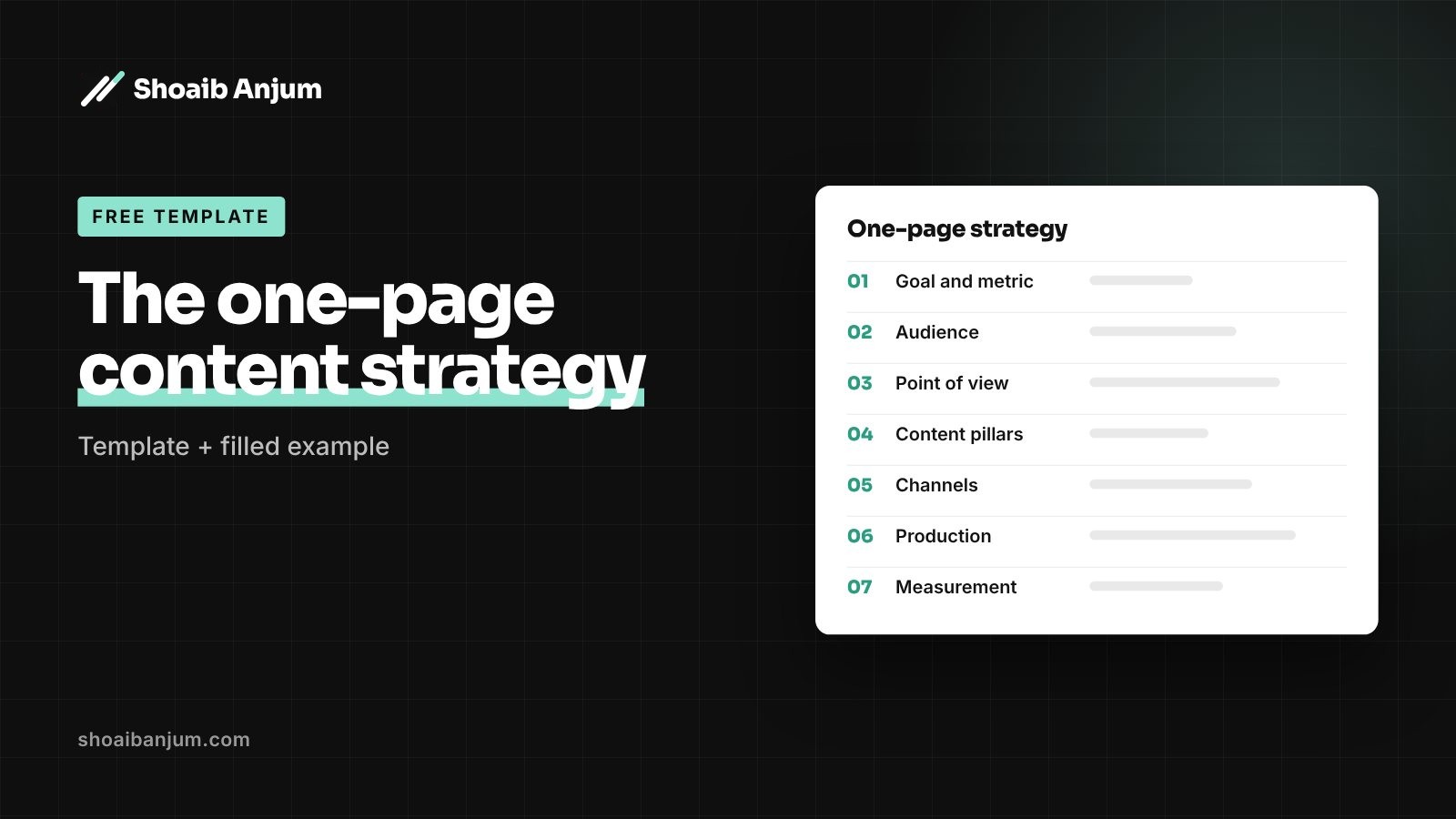
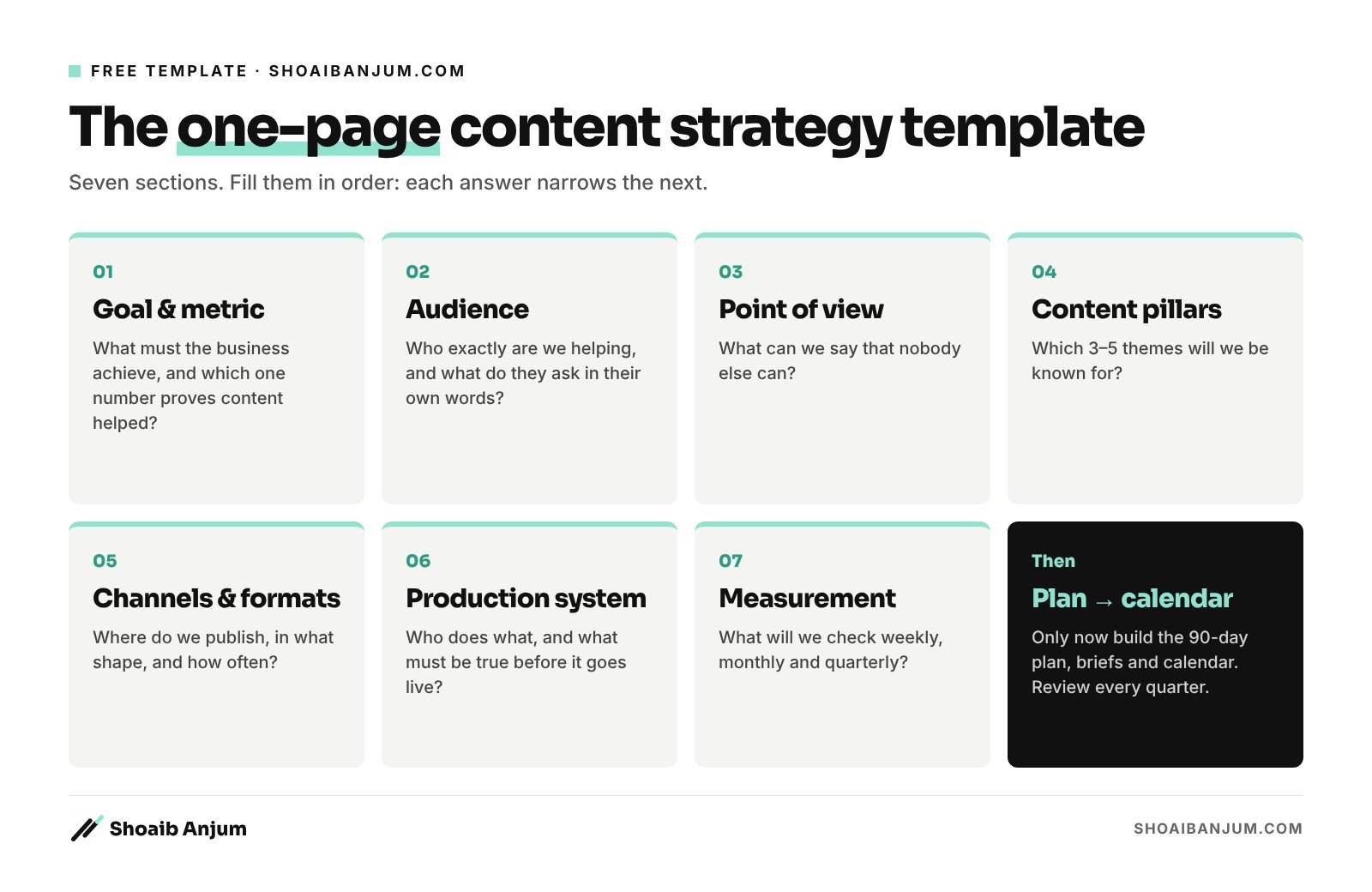
- A good content strategy template fits on one page and answers seven questions: goal, audience, point of view, pillars, channels, production and measurement.
- Fill it in this order. Each section narrows the next, so by the time you reach the calendar, most of the decisions are already made.
- Below you’ll find the copy-and-paste template, a fully filled-in example, a 90-day rollout plan and the five mistakes that quietly turn templates into shelfware.
Let me guess. You downloaded a content strategy template once. It had eleven tabs, a colour-coded calendar and a section called “brand archetype.” You filled in the first tab with real enthusiasm, and then… life happened. The file is still sitting in your Drive, judging you quietly.
You’re not the problem. Most templates are built to look thorough, not to help you decide anything. After years of planning content for YouTube channels, creators, SaaS blogs and publishers, I’ve trimmed my own planning document down to one page with seven sections. It’s the same structure I use with clients, and today you get the whole thing, plus a filled-in example so you can see exactly what “good” looks like.
Grab a coffee. By the end of this, you’ll have a strategy you can actually ship.
What a content strategy template is (and what it isn’t)
A content strategy template is a fill-in-the-blanks document that turns your business goals into clear content decisions: who you’re creating for, what you’ll talk about, where you’ll publish, how it gets made and how you’ll know it’s working.
Notice what’s missing from that list: a calendar. The calendar is what comes out of the strategy, not the strategy itself. People mix these up constantly, so here’s the quick way to tell them apart:
| Document | Question it answers | Time horizon | Changes how often |
|---|---|---|---|
| Content strategy | Why are we publishing, for whom, and about what? | 6–12 months | Reviewed quarterly |
| Content plan | Which pieces are we making next, in what priority? | 90 days | Monthly |
| Content calendar | What goes live on which day, and who owns it? | 2–6 weeks | Weekly |
| Content brief | What exactly should this one piece say and do? | One piece | Per piece |
Mentor note: if your team argues about topics every week, you don’t have a calendar problem. You have a strategy gap. Fix the top layer and the weekly arguments mostly disappear.
The 7-part content strategy template
Here’s each section, what to write in it, and the questions I ask clients to get honest answers. Keep every section short. If a section runs longer than half a page, you’re writing an essay, not making a decision.
1. Goal and the one metric that matters
Start with the business, not the content. What does the business need in the next 6 to 12 months, and what’s the single number that tells you content is helping?
- Business goal: e.g. “Book 8 qualified sales calls a month.”
- Content’s job: e.g. “Bring in buyers who are already comparing solutions, and warm them up before the call.”
- North-star metric: one number. Calls booked from content, email sign-ups, trial starts. Not “engagement.”
One metric feels restrictive at first. It’s actually freeing. It gives you permission to ignore the shiny stuff.
2. Your audience (one reader, described well)
Pick one primary reader. Not three personas with alliterative names. One real person you can picture. Write down:
- Who they are and what situation they’re in right now
- The problem keeping them up at night, in their words
- The questions they type into Google, YouTube or ChatGPT
- What they’ve already tried, and why it didn’t work
- What would make them trust you enough to take the next step
The best sources aren’t brainstorms. They’re sales calls, support emails, reviews, Reddit threads and the comments under your competitors’ videos. If you want a structured way to do this, my free audience avatar template walks you through it step by step.
3. Your point of view
This is the section most templates skip, and it’s the one that makes your content worth reading. Answer these in a sentence or two each:
- What do you believe about your industry that most people get wrong?
- What can you say that a competitor (or an AI tool) can’t, because of your experience, data or results?
- Finish this line: “We’re the people who…”
A quick pass through what competitors already publish helps here. You’re looking for the angle nobody is taking. My competitor analysis template makes that a 90-minute job instead of a lost week.
Mentor note: in a world where anyone can generate a decent 1,500-word article in seconds, your point of view is the product. Google’s own guidance rewards content that shows first-hand experience and real expertise. Generic is the one thing you can’t afford to be.
4. Content pillars
Pillars are the three to five themes you’ll return to again and again. Each one should connect to something you sell or believe, and each should be big enough to hold dozens of pieces. I’ve written a whole guide on how to choose your content pillars, but the short test is this:
- Does my reader care about it? (Section 2)
- Do I have something distinct to say about it? (Section 3)
- Does it lead naturally to what I sell? (Section 1)
Three yeses and it’s a pillar. Two yeses and it’s an occasional topic. One yes and it’s a distraction, however fun it would be to write.
5. Channels, formats and rhythm
Now decide where each pillar lives and in what shape. The trick is to pick a home base (usually your website, newsletter or YouTube channel) and treat everything else as a way to send people there.
| Channel | Role | Format | Realistic rhythm |
|---|---|---|---|
| Website / blog | Home base: search traffic and trust | Guides, comparisons, case studies | 2–4 pieces a month |
| Newsletter | Relationship and conversion | One idea, one story, one link | Every 1–2 weeks |
| LinkedIn or X | Reach and conversation | Short posts cut from long pieces | 3 posts a week |
| YouTube / short-form | Discovery and personality | Explainers, behind-the-scenes clips | 1 long or 3 short a week |
Be honest about capacity. A rhythm you keep for a year beats an ambitious one you drop in six weeks. If search is part of the plan, a little keyword research here will tell you which topics already have demand. And if the rhythm needs more writing hours than your team has, here’s how to hire a copywriter without the guesswork.
6. Production system
This is where strategies usually die: nobody decided how the content actually gets made. Write down:
- Workflow: idea → brief → draft → edit → publish → distribute
- Owners: one name per step, even if it’s the same name every time
- Briefs: a short brief for every piece (angle, reader, key points, call to action)
- Quality gates: what must be true before anything goes live (facts checked, first-hand example included, clear next step)
- Where AI helps: research, outlines, repurposing, formatting. And where it doesn’t: your opinions, your stories, your final edit
If you’re scaling output with AI, this section matters twice as much. I’ve broken down what actually gets AI content penalised and how I build AI content workflows with human review built in, so you get the speed without the risk.
7. Measurement and review rhythm
Finally, decide what you’ll look at and when. Mix leading indicators (early signs things are working) with lagging indicators (the results you actually want).
| Type | Examples | Check it |
|---|---|---|
| Leading | Pieces published on time, impressions, email open and click rates, average watch time | Weekly |
| Middle | Organic visits to key pages, newsletter sign-ups, returning readers | Monthly |
| Lagging | Calls booked, trials, sales influenced by content | Quarterly |
Put a recurring quarterly review in the calendar right now, before you forget. Every six to twelve months, run a proper content audit to decide what to keep, update, merge or remove.
The copy-and-paste template
Here’s the blank version. Copy it into a Google Doc, Notion page or the back of an envelope (I won’t judge). The prompts in the right-hand column are the questions to answer, not decorations.
| Section | Fill this in | Prompt to answer |
|---|---|---|
| 01 · Goal | Business goal: Content’s job: North-star metric: | What must happen in the business in 6–12 months, and which single number shows content helped? |
| 02 · Audience | Primary reader: Their problem: Top 10 questions: | Who exactly are we helping, and what do they search for in their own words? |
| 03 · Point of view | We believe… Only we can say… We’re the people who… | What do we know from experience that others don’t, or won’t, say? |
| 04 · Pillars | Pillar 1: Pillar 2: Pillar 3: | Does the reader care, do we have something distinct to say, and does it lead to what we sell? |
| 05 · Channels | Home base: Supporting channels: Rhythm: | Where do our readers already spend time, and what can we sustain for a year? |
| 06 · Production | Workflow: Owners: Quality gates: AI’s role: | Who does what, and what must be true before anything goes live? |
| 07 · Measurement | Leading: Lagging: Review dates: | What will we check weekly, monthly and quarterly, and when is the next review? |
A filled-in example
Templates make far more sense once you see one filled in, so here’s an example. Penny & Pine is a made-up bookkeeping studio for freelance designers and photographers. Fictional business, realistic decisions.
| Section | Penny & Pine’s answers |
|---|---|
| 01 · Goal | Sign 10 new monthly bookkeeping clients this year. Content’s job: attract freelancers in their first two years of self-employment and make tax season feel less scary. North-star metric: discovery calls booked from content. |
| 02 · Audience | A freelance designer, 1–3 years in, earning well but terrified of their first big tax bill. Searches things like “how much to save for taxes freelance” and “what can I expense as a designer.” |
| 03 · Point of view | “Money admin should take 20 minutes a week, not a lost weekend every April.” Only Penny & Pine can share anonymised patterns from hundreds of creative freelancers’ books. |
| 04 · Pillars | Tax without tears · Pricing and getting paid · Simple money systems · Behind the books (real, anonymised stories) |
| 05 · Channels | Home base: blog (2 guides a month). Newsletter every two weeks. Instagram carousels cut from each guide, 3 a week. |
| 06 · Production | Founder records a 20-minute voice note per topic, writer turns it into a draft, founder approves numbers and examples. AI used for outlines and carousel drafts only. |
| 07 · Measurement | Weekly: posts published, newsletter clicks. Monthly: organic visits to guides, sign-ups. Quarterly: discovery calls and clients from content. |
And here’s how Penny & Pine might split its effort across those pillars. The biggest share goes to the pillar closest to the sale, while the story-led pillar does the trust-building in the background.
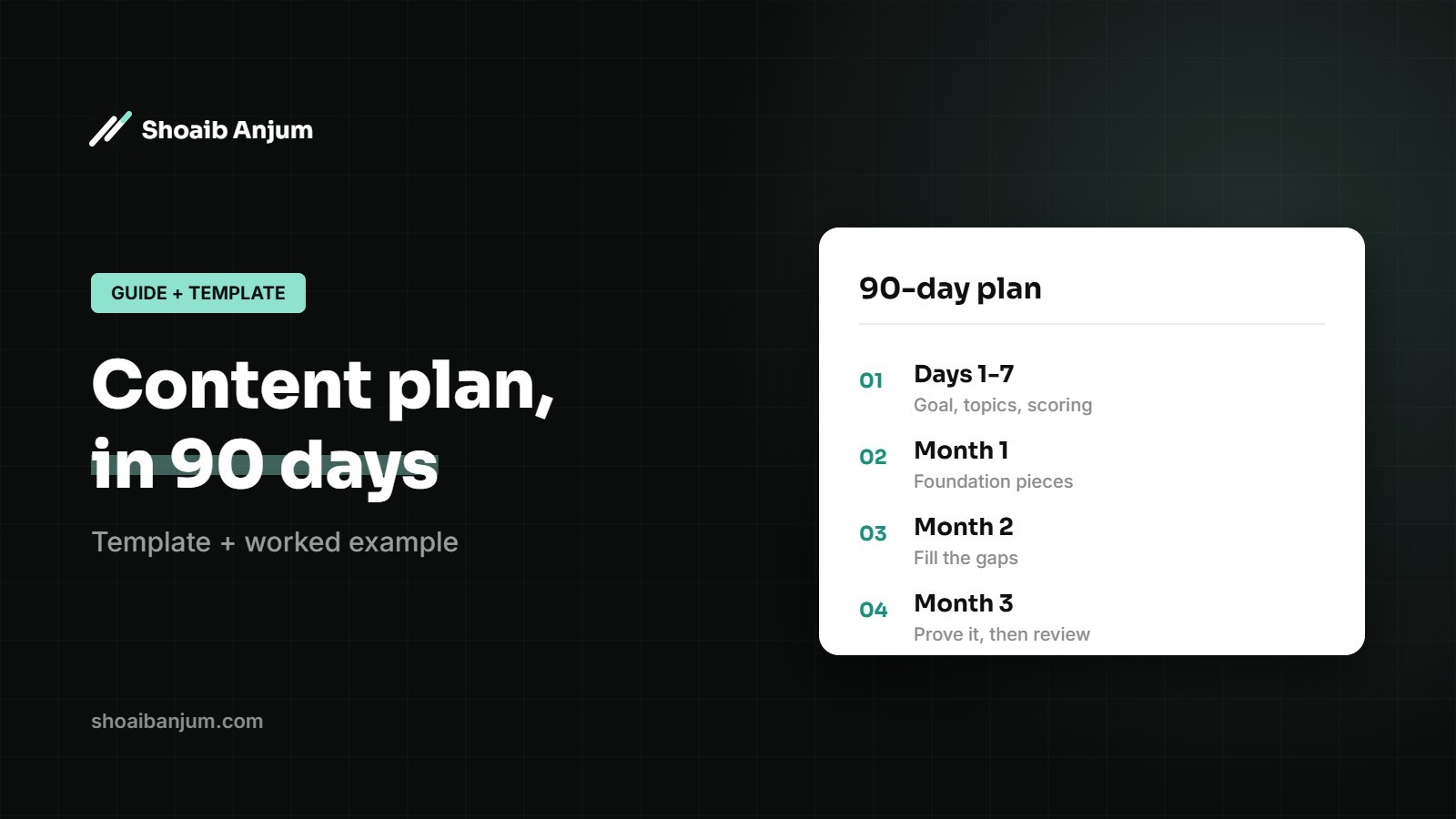
How to roll it out in your first 90 days
A strategy isn’t finished when the document is. It’s finished when you’ve published against it, learned something and adjusted. Here’s the rhythm I use:
Research
Interview customers, mine reviews and comments, scan competitors, gather search data.
Decide
Fill in the seven sections, pick pillars, build a 90-day plan and the first ten briefs.
Publish & learn
Ship on rhythm, distribute every piece, track leading indicators weekly.
Review
Compare results to your metric, double down on what’s working, rewrite what isn’t.
Mentor note: resist rewriting the strategy in week six because one post flopped. Give each pillar at least a full quarter before you judge it. Content compounds, and early data is noisy.
5 mistakes that turn templates into shelfware
- Starting with the calendar. Dates before decisions means you’ll fill slots with whatever’s easiest, not whatever matters.
- Writing for everyone. Three personas usually means zero clear readers. Pick one and go deep.
- Skipping the point of view. Without it, your content sounds like everyone else’s, and readers (and search engines) notice.
- Planning more than you can produce. An ambitious plan you abandon in March is worse than a modest one you keep all year.
- Never reviewing it. A strategy is a living document. If nobody opens it after launch day, it’s just a nicely formatted wish.
Where to keep your template
The tool matters far less than the habit of opening it. That said, here’s how I’d choose:
| Tool | Best for | Watch out for |
|---|---|---|
| Google Docs | Solo founders and small teams who want a simple shared doc | It drifts away from the calendar unless you link the two |
| Notion | Teams who want strategy, briefs and calendar in one connected space | Easy to over-build. Keep the strategy page to one screen |
| Google Sheets | Calendars, content inventories and tracking metrics | Clunky for the thinking sections like point of view |
I keep mine in Notion, and you can grab my free Notion templates for the research sections (audience, competitors, pillars and keywords). They’re the same ones I use with paying clients.
FAQ
What should a content strategy template include?
At minimum: your business goal and one key metric, a clearly defined audience, your point of view, three to five content pillars, your channels and publishing rhythm, a production workflow with owners, and how and when you’ll measure results.
How long should a content strategy document be?
One page for the core decisions. Supporting research (customer interviews, keyword lists, competitor notes) can live in linked documents, but anyone on your team should be able to read the strategy itself in five minutes.
What’s the difference between a content strategy and a content marketing strategy?
In practice, most people use them interchangeably. Strictly speaking, content strategy covers all the content a business creates, including product, help and website copy, while content marketing strategy focuses on content used to attract and convert customers. This template works for both.
How often should I update my content strategy?
Review it every quarter and adjust pillars, channels and rhythm based on results. Revisit the goal and audience sections once a year, or whenever your business changes direction.
Can I use AI to fill in a content strategy template?
AI is genuinely useful for summarising research, spotting patterns in customer questions and drafting first versions of sections. But the goal, the point of view and the trade-offs need human judgement, because they depend on your business, your experience and your appetite for risk.
Your turn
You don’t need a perfect strategy. You need a clear one that you’ll actually use. Block out two focused hours this week, work through the seven sections in order, and publish your first piece against it. Then come back in 90 days and tell me what you learned. I’d genuinely love to hear it.
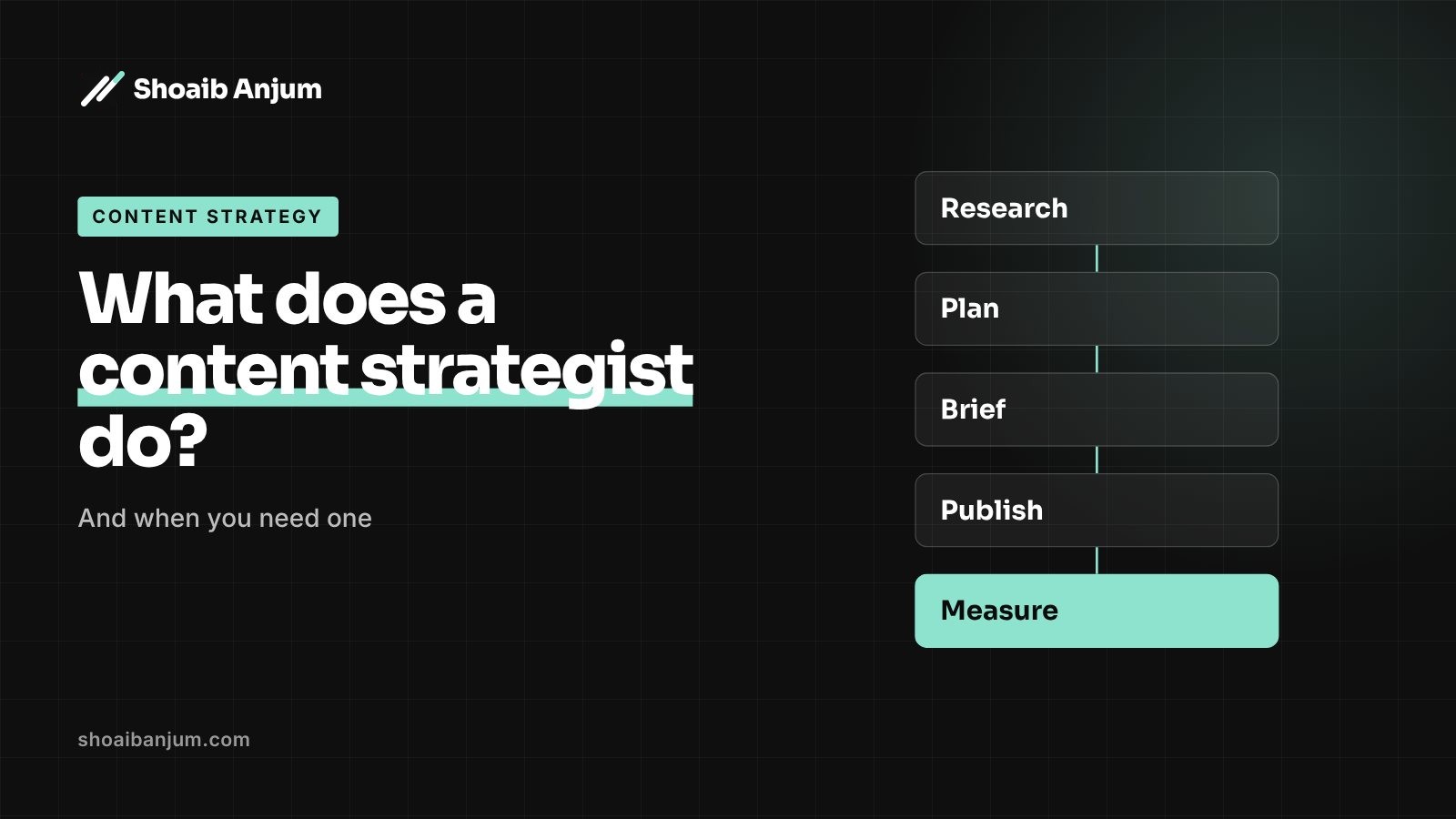
And if you’d rather have a second brain on it, this is exactly what I do. I’ll research your audience, sharpen your point of view and hand you a plan your team can ship. Have a look at my content strategy services, or if you’re still deciding whether you need help at all, here’s what a content strategist actually does.
Shoaib Anjum
Freelance content strategist and copywriter. 50+ clients since 2017, 12M+ views on scripted videos, and 12+ content engines running with an E-E-A-T check on every piece.
Want a content plan built for your business?
Every project starts with a short call and a fixed-price written proposal.