Content Plan: How to Build a 90-Day Plan (With Template and Example)
Build a content plan in six steps: set one goal, score topics, pick a rhythm you can keep. Includes a copy-and-paste template and a worked example.
 By Shoaib AnjumContent strategist & copywriter
The short version:
- A content plan turns your strategy into a ranked list of what to make over the next 90 days, with owners, dates and one number that tells you whether it worked.
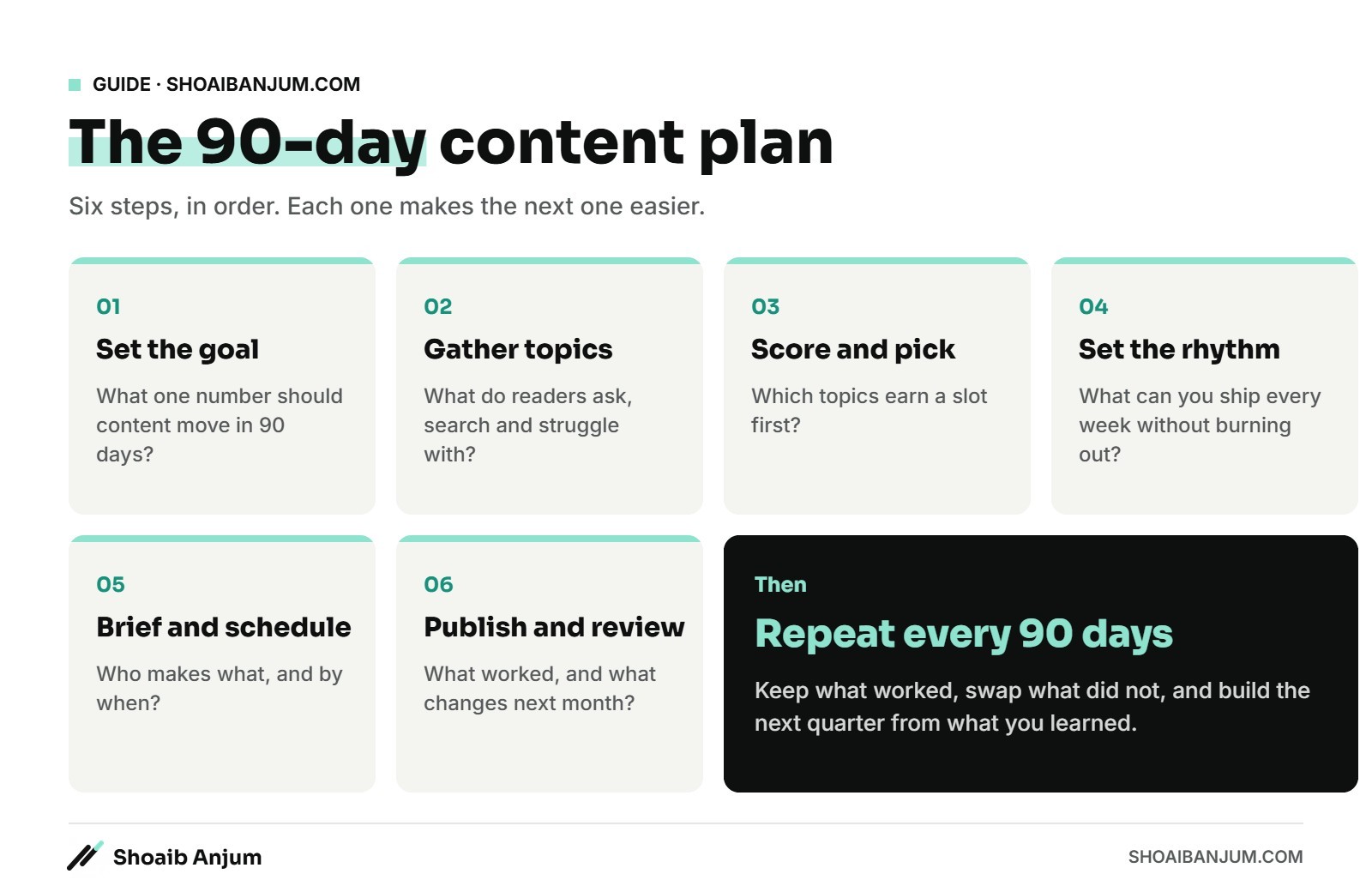
- Build it in six steps: set one goal, gather topics, score them, pick a rhythm you can really keep, brief and schedule, then publish and review monthly.
- Below you’ll find a copy-and-paste template, a scoring table, a filled-in example with made-up numbers, and the mistakes that quietly kill most plans by week three.
Every content plan I’ve ever seen starts the same way. Sunday evening, fresh coffee, a spreadsheet with forty-seven brilliant ideas and a calendar colour-coded like a rainbow. By Wednesday, one idea is half-written, three are “on hold,” and the rainbow has quietly turned grey.
That isn’t a motivation problem. It’s a design problem. Most plans ask for more than a real week can hold, and they never say which ideas matter most. Let’s fix both, and keep the whole thing small enough that you’ll still be using it in month three.
What a content plan is (and how it differs from your strategy)
A content plan is the practical document that lists which pieces you will create, who is making them, where they will be published and when. Mailchimp draws the line neatly: content planning is the tactical side of creating, scheduling and distributing, while strategy holds the bigger vision and goals.
If those terms keep blurring together for you, this table separates them:
| Document | Question it answers | Horizon | Reviewed |
|---|---|---|---|
| Content strategy | Why are we publishing, for whom, and about what? | 6–12 months | Quarterly |
| Content map | Which piece serves which reader at which stage? | Ongoing | Quarterly |
| Content plan | Which pieces are we making next, in what order, and who owns each? | 90 days | Monthly |
| Content calendar | What goes live on which day? | 2–6 weeks | Weekly |
If you haven’t settled the strategy yet, start with my one-page content strategy template. And if you’re not sure which readers and stages to cover, the guide to content mapping will give you the topic list this plan draws from.
Mentor note: a plan is allowed to be boring. Ninety days, one goal, ten to twenty pieces. If it takes more than an hour to explain to a colleague, it’s a project, not a plan.
Why most plans fail: speed beats quality
The latest B2B research from the Content Marketing Institute is a useful reality check. In its 2027 trends report (861 B2B marketers, surveyed June to August 2026), 65% said the pressure to produce content faster had risen over the past year. When asked what AI had contributed to their content, 78% said speed, but only 17% said quality.
Now compare that with what the same marketers say drives results: of those who rated their marketing effective, 47% credited content relevance and quality, the most common answer. Speed isn’t on the leaderboard.
That tells you what a good plan should protect. Mailchimp warns that prioritising quantity over quality almost always backfires, and I’d add a practical corollary: a plan should decide what not to make, so the pieces that remain get proper time.
The six steps
Step 1: Set one goal and one number
Pick a single outcome for the next 90 days and the number that proves it. Sprinklr suggests making goals specific, measurable, actionable, relevant and time-bound, such as lifting monthly organic traffic by a set percentage within six months. For a service business, my favourite numbers are enquiries from content, email sign-ups, or the number of published pieces that rank on page one for a target phrase.
Write it as one sentence: “By the end of the quarter, content will bring us X, measured by Y.” If you can’t finish that sentence, stop here until you can.
Step 2: Gather topics from three places
Don’t brainstorm from a blank page. Collect topics from sources that already carry evidence:
- Your content map. The gaps you found by stage are your highest-value topics. See how to build the map if you don’t have one.
- Search demand. Use keyword research to see what people type and how hard it is to rank. My keyword research guide walks through it.
- Real questions. Customer emails, sales calls, comments, search queries in your analytics. Sprinklr also recommends reviewing your existing content to spot what has already earned engagement and traffic.
Dump everything into one sheet. Quantity is fine at this stage, because the next step does the cutting.
Step 3: Score and pick
Here’s the part most plans skip. Give every topic a score from 1 to 3 on three questions, then add them up:
| Criterion | Score 1 | Score 2 | Score 3 |
|---|---|---|---|
| Impact on the goal | Nice to have | Helps indirectly | Directly supports the goal number |
| Demand | Few people ask | Steady interest | Clear, repeated demand |
| Ease | Needs new research or heavy production | Doable in a week | I can make this well in a day or two |
Cross-check the winners against your pillars. If a high-scoring topic doesn’t fit any of the three to five themes you want to be known for, either it’s a one-off or your pillars need work. My content pillars guide helps with that.
Step 4: Set a rhythm you can keep
Work backwards from your real capacity. Take the hours you can honestly spend on content each week, divide by the hours one good piece takes, and round down. If you have six hours a week and a solid guide takes five, your rhythm is about one guide a week, not three.
That number, multiplied by 12 weeks, is your ceiling. Twelve pieces made well beat thirty made badly, and consistency matters more than bursts. Mailchimp lists inconsistent publishing as one of the planning mistakes that erodes audience trust, so set the rhythm low enough that you can hit it in a bad week.
Step 5: Brief, assign and schedule
Now turn your top-scoring topics into a short list of dated pieces. For each one, write a brief before anyone starts drafting: the reader, the question, the stage, the angle, the sources to open and the next step the reader should take. A brief takes fifteen minutes and saves hours of rewriting.
Then put each piece on the calendar with an owner, a status and a publishing date, as Mailchimp suggests, and note how it will be promoted. If you work with writers, a clear brief is also the best thing you can hand them. It’s where a good copywriter earns their keep, and where a vague one costs you revision rounds.
Step 6: Publish, reuse and review monthly
Publishing isn’t the end of a piece’s job. Plan how each one gets reused: a guide becomes a short video script, three social posts and an email. Mailchimp’s advice on repurposing is to design pieces with that in mind from the start.
Once a month, spend 30 minutes with three questions:
- What moved the number? Which pieces contributed most to the goal from step 1?
- What stalled? Which pieces are late, and why? Usually the answer is “we planned too many.”
- What changes next month? Swap, drop or add one or two items. Don’t rebuild the whole plan.
Mentor note: when a piece is clearly outdated or underperforming, updating it often beats writing a new one. My guide to doing a content audit shows how to decide which is which.
The 90-day content plan template (copy and paste)
One row per piece. These are the columns I’d keep, and no more:
| Column | What to write | Example |
|---|---|---|
| Month and week | When it should go live | Month 1, week 2 |
| Working title | The piece, in plain words | Traffic up, sales flat: five checks |
| Pillar | Which theme it belongs to | Understanding your numbers |
| Reader and stage | Who it is for and where they are | Shop owner, awareness |
| Format and channel | Type of piece and where it lives | Guide on the blog, plus email |
| Score | Impact + demand + ease (3 to 9) | 8 |
| Owner | Who is accountable | Sam |
| Status | Idea, briefed, drafting, review, live | Briefed |
| Next step for the reader | The one thing they should do after reading | Read “what to track” |
| Result | The number you’ll check after 30 days | Click-through to the next guide |
A filled-in example
Let’s use “Tidewell Analytics” again, the invented two-person consultancy from my content mapping guide that helps small online shops understand their numbers. Everything here, including the numbers, is made up for illustration.
Goal: by day 90, content will bring 10 qualified enquiries, measured by the contact form. Capacity: one new piece a week, so about 12 in total. The map showed plenty of awareness content and almost nothing at decision, so the plan leans downstream.
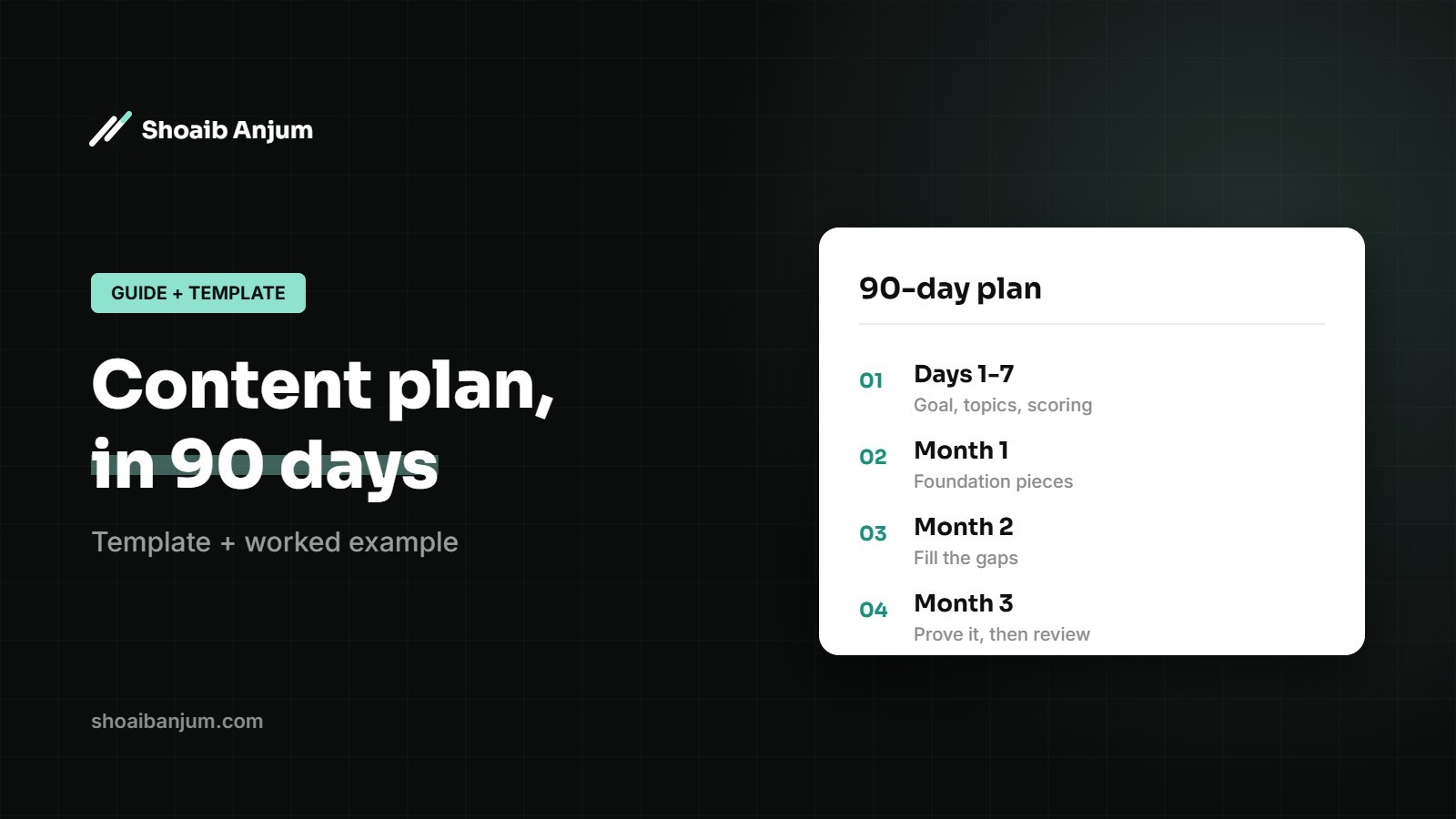
Set up
Write the goal sentence, collect 40 topics, score them and keep the top 12.
Proof first
Ship the case study and the service page rewrite, then two high-demand guides.
Fill the middle
Publish the comparison, the dashboard template and the “DIY or hire” checklist.
Prove and review
Refresh the best performer, add after-purchase content, then review against the goal.
| Week | Piece | Stage | Score |
|---|---|---|---|
| 1–2 | Case study with one measurable result | Decision | 9 |
| 3 | What the six-week setup includes (service page rewrite) | Decision | 9 |
| 4 | Traffic up, sales flat: five checks | Awareness | 8 |
| 5 | The four numbers every small shop should watch | Awareness | 8 |
| 6 | DIY analytics vs a consultant | Consideration | 8 |
| 7 | A one-page dashboard, filled in (template) | Consideration | 7 |
| 9 | Monthly review checklist | After purchase | 6 |
Five mistakes that sink content plans
- No goal number. Without one, every idea looks equally good, and you can’t tell at day 90 whether the plan worked.
- Planning past your capacity. The plan is a promise. Set it to what you can deliver in a bad week.
- Skipping the scoring. Without it, the loudest idea wins, not the most useful.
- Briefing after drafting. If the brief comes second, you’re paying for the thinking twice.
- Never reviewing. A plan nobody revisits is a wish list. Put the monthly 30 minutes in the calendar now.
Where AI fits in a content plan
AI is useful in the planning stage: clustering the questions you’ve collected, drafting briefs, and spotting duplicates. The same CMI report found that 88% of B2B marketers say their organisation uses AI content tools, and their biggest hurdles are ensuring accuracy (54%), quality control (54%) and keeping brand voice authentic (52%).
So build those checks into the plan itself. Add a fact-check and a voice review to every piece’s status column, and keep a real person’s experience or data in each one. I’ve written separately about what actually gets sites hit when they use AI, and if you want a repeatable system around it, that’s what my content engines are for.
FAQ
What is a content plan?
A content plan is a document that lists the content you’ll create over a set period, with goals, topics, formats, owners, deadlines and publishing channels. It turns your strategy into specific, scheduled work.
What’s the difference between a content plan and a content strategy?
Strategy decides why you publish, for whom and about what. The plan decides which pieces you’ll make next, who owns them and when they go live. You need the strategy first, or the plan is just a list of guesses.
What’s the difference between a content plan and a content calendar?
A content plan covers priorities across roughly 90 days: what, why and in what order. A calendar is the day-by-day view of the next few weeks. The calendar is generated from the plan, not the other way around.
How far ahead should I plan content?
Ninety days is a good horizon for most small teams and solo experts. It’s long enough to see results and short enough to stay realistic. Plan the first month in detail, the second in outline and the third loosely, then review monthly.
How do I make a social media content plan?
Use the same six steps, with one extra layer: for each core piece (like a guide or video), list the social posts, clips or carousels you’ll reuse from it, and which channel each goes to. Start with one or two channels you can keep up, rather than every platform.
How often should I update my content plan?
Review it monthly and swap one or two items. Rebuild it fully every 90 days using what you learned, and revisit the underlying strategy once a quarter.
Your turn
Set aside 90 minutes this week. Write your goal sentence, collect topics from your content map, keyword research and real questions, score them, and keep only as many as you can honestly ship. Then publish the first one.
If you’d rather have a second brain on it, this is exactly what I do. I’ll turn your strategy into a scored, briefed 90-day plan your team can run. Have a look at my content strategy services, or if you’re still working out whether you need help at all, here’s what a content strategist actually does. You can also tell me about your project and I’ll point you in the right direction.
Sources
- Content Marketing Institute: Faster and Cheaper, But Not Better, the 2027 B2B Content and Marketing Trends report (4 November 2026; 861 B2B marketers, surveyed June to August 2026)
- Mailchimp: Essential Content Planning Tips for Smarter Marketing
- Sprinklr: How to Create a Content Plan
Shoaib Anjum
Freelance content strategist and copywriter. 50+ clients since 2017, 12M+ views on scripted videos, and 12+ content engines running with an E-E-A-T check on every piece.
Want a content plan built for your business?
Every project starts with a short call and a fixed-price written proposal.