Content Mapping: How to Map Content to the Buyer Journey (With Template and Example)
Learn content mapping in six steps: match each piece to one reader, one stage and one next step. Includes a free template and a worked example.
 By Shoaib AnjumContent strategist & copywriter
The short version:
- Content mapping means giving every piece of content one reader, one stage of their decision and one next step. The output is a one-page grid you can read in a minute.
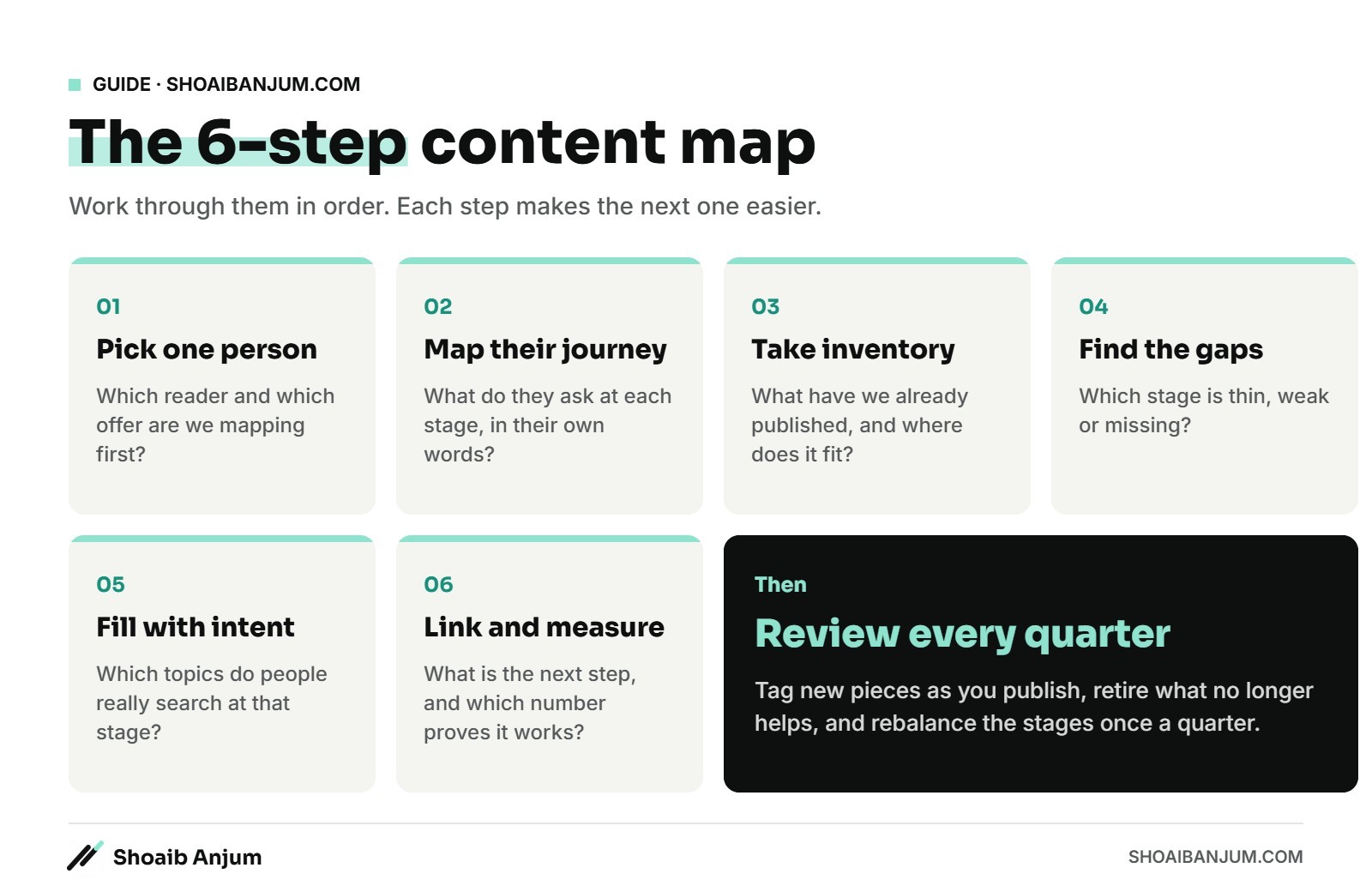
- Do it in six steps: pick one audience and offer, write their journey in their own words, list what you’ve already published, spot the gaps, fill them with topics people really search, then link it all together and review quarterly.
- Below you’ll find a copy-and-paste template, a filled-in example (with made-up numbers), a four-week rollout and the mistakes that turn content maps into wall art.
Here’s a scene I’ve watched play out more times than I can count. A business has sixty blog posts. Fifty-two of them explain what something is. Seven compare options. One, buried three clicks deep, explains how to actually hire the business. Readers arrive, nod, learn something, and leave, because nobody built them a path.
Content mapping is how you build the path. And it’s far less scary than the flowcharts make it look. If you can fill in a spreadsheet and answer “what does this reader need next?”, you can do it this afternoon.
What content mapping is (and what it isn’t)
Content mapping is the process of matching each piece of content to a specific audience, a stage in their buying journey and a goal. The result, a content map, is a simple document that shows which questions you already answer, which you don’t, and what each piece should lead to.
People often blur it with its neighbours, so here’s how to tell them apart:
| Document | Question it answers | What you get |
|---|---|---|
| Content map | Which piece serves which reader, at which stage, with what next step? | A grid of audiences × stages, filled with content |
| Buyer persona | Who exactly are we talking to? | A one-page profile of the reader |
| Keyword research | What do people actually type when they have this question? | A list of topics with demand attached |
| Content plan / calendar | What are we making next, and when does it go live? | A prioritised, dated production list |
Mentor note: if you can’t say which single question a piece answers and what the reader should do afterwards, it isn’t mapped yet. It’s just published.
Why bother: your content is doing the selling
Buyers increasingly work things out on their own before they ever talk to you. A Gartner survey of 646 B2B buyers, run in August and September 2025, found that 67% prefer a rep-free experience, and 45% had used AI during a recent purchase. You may not sell to enterprise committees, but the direction of travel is the same for freelancers, creators and small businesses: people research quietly, in pieces, and form a view before they send you a message.
That makes your pages the conversation. And two things go wrong when nobody maps them:
- The missing middle. You publish loads of awareness posts and nothing for people comparing options. As Search Engine Land’s guide points out, a competitor with decent consideration content can pick up your readers exactly where you stopped helping them.
- Pieces without a job. Without a map, each post is an island. It might rank, it might get shared, but it doesn’t lead anywhere, so nobody can tell whether it was worth the effort.
The six steps
Step 1: Pick one person and one offer
Start with a single persona and a single thing you sell. Not five personas. Not “everyone who might ever need us.” You can add more once the first map works.
A persona doesn’t need to be a glossy PDF. Semrush’s funnel guide boils it down to four questions, and they’re a good minimum:
- Who are they? Role, industry, experience level.
- What do they need? The problem, the motivation, what “success” looks like to them.
- What limits their decision? Budget, time, expertise, who else has to approve it.
- What might stop them choosing you? The doubts and misconceptions you’ll need to answer.
If you’d like a ready-made worksheet for this, my audience avatar template walks through it. Talk to two or three real customers if you can. One honest conversation beats an hour of guessing.
Step 2: Map their journey in their own words
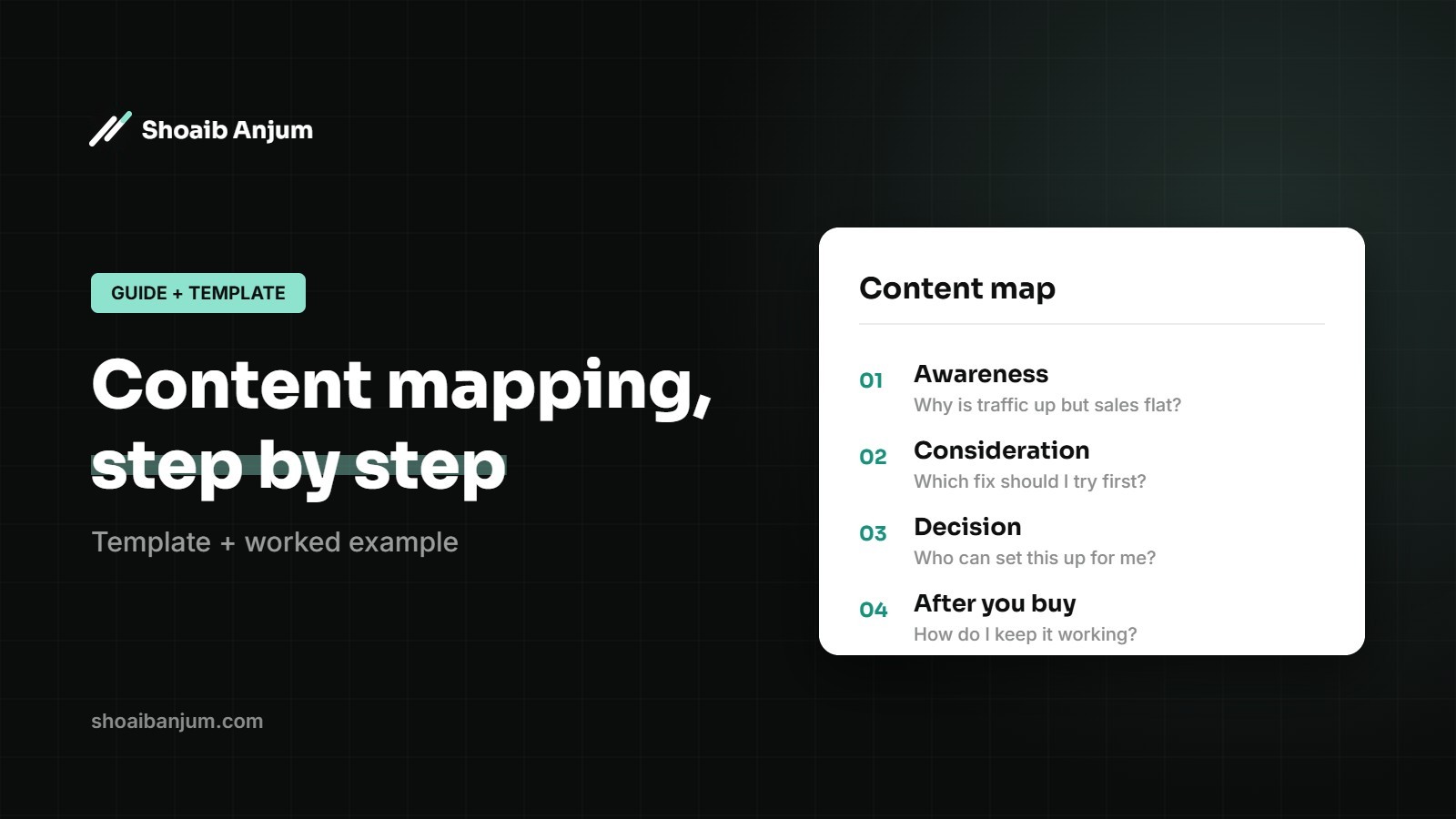
Now write down what your persona is thinking at each stage. The classic three-stage version is awareness, consideration and decision, and I like to add a fourth for the time after they buy, because that’s where referrals and repeat work come from. The important part is that you write the questions, not the topics. Questions keep you honest.
| Stage | What they’re thinking | Content’s job | Typical formats | Natural next step |
|---|---|---|---|---|
| Awareness | “Something’s wrong, and I’m not sure what.” | Help them name and understand the problem | Guides, explainers, checklists, short videos | Read a deeper guide or join the email list |
| Consideration | “I know the problem. What are my options?” | Compare approaches and show how you think | How-tos, comparisons, templates, webinars | Download a template or view a case study |
| Decision | “Who should I trust with this?” | Prove results and remove doubt | Case studies, testimonials, service pages, pricing guidance | Book a call or send an enquiry |
| After they buy | “Am I getting my money’s worth?” | Help them succeed and stay | Onboarding, how-to’s, updates, community | Refer someone or buy again |
How many stages should you use? Semrush suggests starting with three if you have a small team, a simple offer or a short sales cycle, and moving to a seven-layer model (adding validation, implementation and advocacy) when buyers need more proof or retention drives your revenue. For most solo experts and small teams, three plus “after they buy” is plenty.
Step 3: Take inventory of what you’ve already published
Before you plan anything new, list every URL you have. A spreadsheet with these columns is enough: URL, title, stage, persona, format, last updated and one result metric (visits, sign-ups or enquiries).
Then tag each piece with the stage it serves best. Ahrefs offers two useful rules in its content map guide. If a piece fits several stages, choose the one with the most dominant use case. If it fits none, either rework it so it has a clear job or retire it.
This step doubles as a mini audit, and a surprising number of people find their best content is sitting unlinked in a corner. If your list is long, my guide to doing a content audit shows how to score and sort it quickly.
Step 4: Find the gaps
Count what you’ve got in each stage. The shape usually tells the story on its own. Here’s a made-up example for a small consultancy that has published twenty pieces:
Look for three things: a thin middle, a decision stage with no proof (case studies, testimonials, a clear service page), and nothing for people who’ve already bought. Write each gap down as a question your persona is asking, not as a topic. “How do I decide between doing this myself and hiring someone?” is a gap you can act on. “Comparison content” is not.
Step 5: Fill the gaps with topics people really search
Now match each gap to search intent, so what you make is something people are looking for. Semrush’s guide suggests a handy rule of thumb:
- Informational searches (“what is…”, “how to…”, “guide to…”) usually belong to awareness.
- Commercial searches (“best…”, “vs”, “alternatives”) usually belong to consideration.
- Transactional searches (“pricing”, “hire”, “buy”) usually belong to decision.
For finding the actual topics, Ahrefs lists four routes that work well together: keyword research, looking at what your competitors rank for that you don’t, listening in the places your audience hangs out, and simply asking your audience what would help. My keyword research guide shows the first one step by step. Aim for topics where you can say something specific and useful, then check what’s already ranking before you commit.
Step 6: Link it together and measure it
A map only works if readers can move along it. Three habits make that happen:
- Give every piece one next step. An awareness guide points to a deeper guide. A comparison points to a template or case study. A case study points to the enquiry page.
- Link along the path, not just sideways. Awareness pieces should link to consideration pieces, and those to your service page, so a reader can keep going whichever page they land on. The same goes for what you’ve already built: my content strategy template is a good place to see how the strategy above the map is laid out.
- Pick one number per stage. For example: visits or impressions for awareness, email sign-ups or downloads for consideration, enquiries for decision, repeat work or referrals after the sale. Review them every quarter and re-tag anything new.
Mentor note: real journeys are messier than the grid. Ahrefs makes the point that one article can serve several purposes, and Semrush, citing Gartner research, notes that B2B buyers loop back to earlier work as new people join the decision. Treat the map as a guide for what to make and where to link, not as a law of nature.
The content mapping template (copy and paste)
Create one sheet per persona and add a row for each piece, existing or planned. These are the columns I’d keep:
| Column | What to write | Example |
|---|---|---|
| Persona | Who this piece is for | Maya, runs a small online shop |
| Trigger | What made them start looking | Sales stayed flat while traffic rose |
| Stage | Awareness, consideration, decision or after they buy | Awareness |
| Their question | In their words, as a question | “Why isn’t more traffic making more sales?” |
| Piece and format | Title (or working title) and type | Guide: five checks to run first |
| Search intent and keyword | Informational, commercial or transactional, plus the main phrase | Informational: “website traffic but no sales” |
| Next step | The one thing the reader should do next | Read the “what to track” guide |
| Status and owner | Live, to update, planned, who and when | Planned, Sam, week 3 |
| Success metric | The single number that tells you it worked | Click-through to the next guide |
A filled-in example
Let’s put it to work. “Tidewell Analytics” is an invented two-person consultancy that helps small online shops make sense of their numbers. Its persona is Maya, who runs a small store and has no analyst on staff. Here’s a slice of the map:
| Stage | Maya’s question | Piece (format) | Next step |
|---|---|---|---|
| Awareness | “Why is traffic up but sales flat?” | Five checks to run first (guide) | Read “which numbers to track” |
| Awareness | “What should I even be tracking?” | The four numbers every small shop should watch (guide + checklist) | Get the dashboard template by email |
| Consideration | “Should I learn this or hire someone?” | DIY analytics vs a consultant (comparison) | Download the decision checklist |
| Consideration | “What would a good setup look like?” | A one-page dashboard, filled in (template) | See how the setup works |
| Decision | “Can I trust you with my shop’s data?” | What the six-week setup includes (service page), plus a case study with one measurable result | Send an enquiry |
| After they buy | “How do I keep this useful?” | Monthly review checklist (email + guide) | Refer another shop owner |
The inventory chart earlier shows where Tidewell started: heavy on awareness, almost empty at decision. So its next six pieces all go to consideration and decision, and the first one it ships is the case study, because that’s the gap costing it enquiries.
How many pieces should each stage get?
There’s no magic ratio, but a starting point helps. Semrush suggests roughly 40% awareness, 40% consideration and 20% decision, then adjusting to your data. If your awareness content is already strong, shift your effort downstream, where enquiries are easier to trace to a page.
Ahrefs describes a different lens that’s worth borrowing if you sell a product or a service: score each topic by how naturally what you sell solves the problem, and only use high-scoring topics for pieces meant to prompt a purchase. For a service business, that translates to “does this piece make my offer obviously relevant?” If not, keep it in awareness or after-purchase, where being useful is enough.
Your first four weeks
Decide
Pick one persona and one offer. Write their four-stage questions in their own words.
Inventory
List every URL, tag the stage, note one result metric, and mark what to update or retire.
Plan the gaps
Turn the biggest gaps into briefs, matched to search intent, with one next step each.
Publish, link, review
Ship the first gap-filler, add the links along the path, then review quarterly.
Five mistakes that make content maps useless
- Starting with five personas. You’ll never finish. Map one, learn, then add the next.
- Mapping topics instead of questions. “Email marketing” is a topic. “Which email tool should I pick as a solo business?” is a question you can answer.
- Overstuffing awareness. It’s the easiest stage to write for, so it fills up first. Check the middle and the end before you add more at the top.
- Forgetting the next step. A piece that ends with nothing is a dead end, however well it ranks.
- Treating the map as finished. Your readers, offers and search results change. Put a quarterly review in the calendar.
A note on AI search
The same discipline helps your pages get summarised accurately by AI tools. Semrush’s guide recommends leading each section with a direct answer and then expanding, backing claims with named sources, and keeping author signals clear. A content map makes that easier, because each piece already knows which question it answers. And no, writing well with AI help isn’t something Google punishes on its own; I unpack that in does Google penalize AI content?
FAQ
What is content mapping?
Content mapping is the process of matching each piece of content to a specific audience, a stage in their decision-making and a clear next step. The finished content map shows what you have, what’s missing and what to make next.
What’s the difference between a content map and a content plan?
The map decides what is worth making: which reader, which stage, which question. The content plan turns that into a prioritised list with dates and owners. Build the map first, otherwise the plan is just a list of guesses.
How many stages should a content map have?
Three is a sound default: awareness, consideration and decision. Add a fourth for the period after someone buys. Longer, more complex sales cycles can justify seven or more, but only if you have the content and the people to support them.
Do I need a content map if I’m a solo creator or freelancer?
Yes, and it can be much lighter. One persona, four stages and about fifteen rows is often enough. It stops you publishing only the content that’s easy to write and helps people find the page where they can hire you.
How often should I update a content map?
Review it every quarter. Re-tag anything you’ve published, retire what no longer helps, and rebalance the stages. Revisit your persona once a year, or sooner if your offer changes.
Can AI build a content map for me?
AI can speed up the grunt work, like tagging an inventory, clustering questions and drafting briefs. But the decisions about who you’re serving, what you want them to do and which gaps matter most depend on your business, so they need your judgement.
Your turn
Block out one hour this week, pick a single persona, and fill in the first twenty rows of the template. You’ll see your gaps faster than you expect. Then publish one piece that fills the biggest one.
If you’d rather have a second brain on it, this is exactly what I do. I’ll sort your existing content, map it to your readers and hand you a plan your team can ship. Have a look at my content strategy services, or if you want to start with what you already have, my content audit service. If you’re still working out whether you need help at all, here’s what a content strategist actually does, or tell me about your project and I’ll point you in the right direction.
Sources
- Gartner: Sales Survey Finds 67% of B2B Buyers Prefer a Rep-Free Experience (press release, 9 March 2026; survey of 646 B2B buyers, August to September 2025)
- Semrush: Content marketing funnel: stages, templates and metrics (29 April 2026)
- Ahrefs: How to Create a Content Map: Traditional Way and Ahrefs’ Way
- Search Engine Land: Content mapping: Who, what, where, when, why and how
Shoaib Anjum
Freelance content strategist and copywriter. 50+ clients since 2017, 12M+ views on scripted videos, and 12+ content engines running with an E-E-A-T check on every piece.
Want a content plan built for your business?
Every project starts with a short call and a fixed-price written proposal.